


24/7 Water Damage Restoration in Denver, Colorado
Emergency water damage restoration in Denver with on-site arrival in 90 minutes. IICRC-certified water extraction, structural drying, mold prevention, and full reconstruction, available 24/7 across the Colorado Front Range.








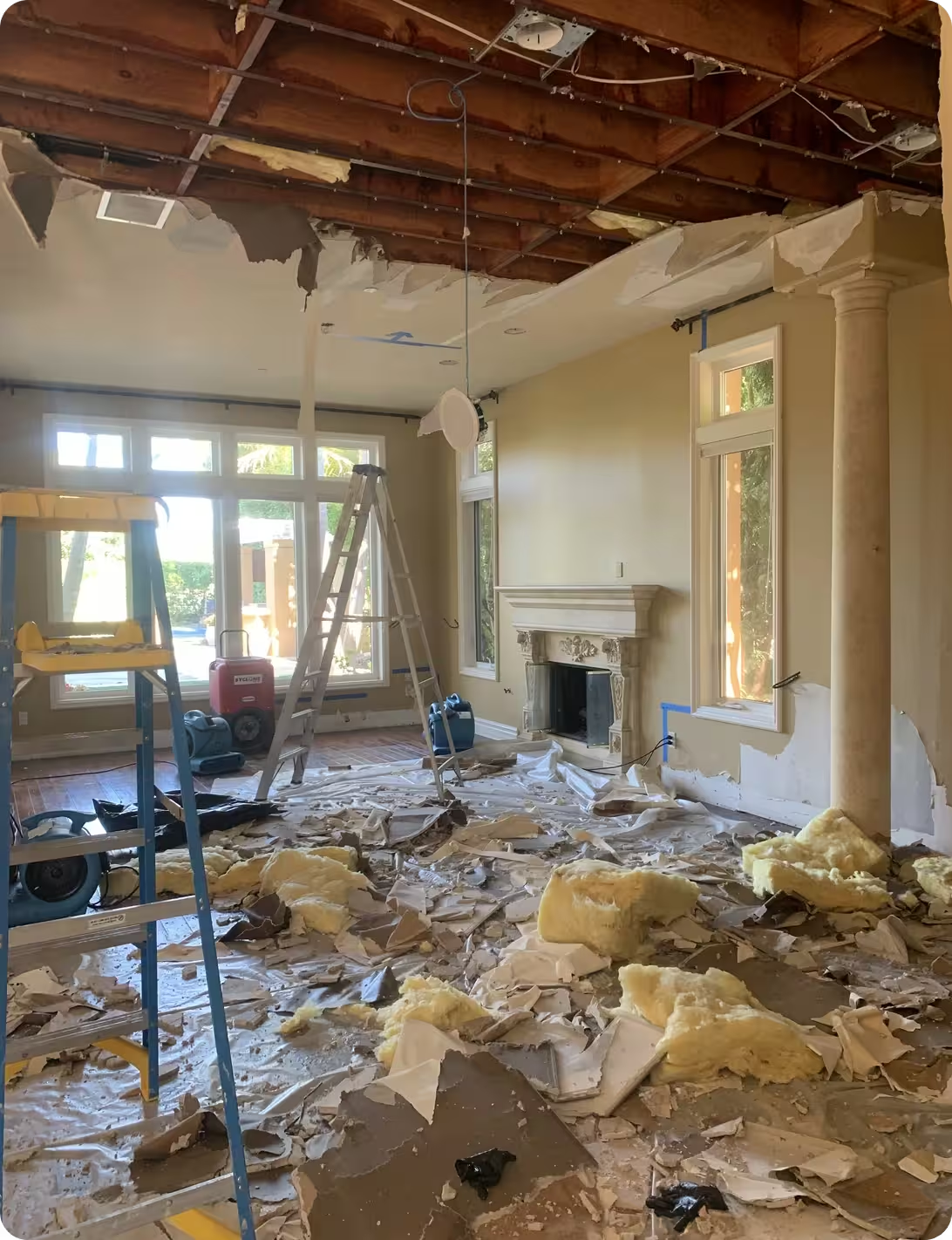

Emergency Water Damage Restoration in Denver, Why Speed Matters
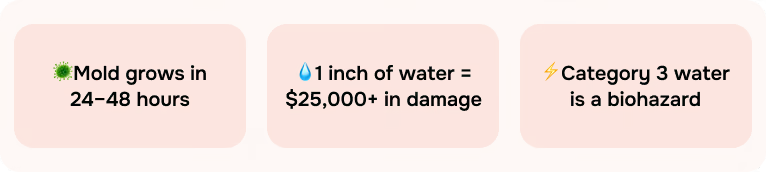
Mold begins growing within 24 to 48 hours of water exposure. Every hour of standing water increases structural damage, raises restoration costs, and puts your family's health at risk. Whether you're dealing with a burst pipe, a failed appliance, or a flooded basement, the clock starts the moment water enters your home.
BoneDry Services provides immediate water damage restoration across Denver and the greater Colorado Front Range. Our IICRC-certified technicians are available 24 hours a day, 7 days a week, and will arrive at your property within 90 minutes of your call. We handle everything from emergency water extraction and structural drying to mold prevention treatment and full reconstruction, so you can focus on your family while we restore your home.
Don't wait. The longer water sits, the deeper it penetrates walls, subfloors, and framing. What starts as a manageable water damage situation can become a full structural repair and a much larger insurance claim, within 48 hours.
Water Damage Categories
Explained: Clean, Grey & Black Water
Clean Water
- Low risk, act within 24 hours
Clean water from a sanitary source, burst supply pipe, overflowing sink, appliance leak. Poses the lowest health risk but can degrade to Category 2 within 24 to 48 hours if left untreated.
Sources: Burst pipes, supply line leaks, overflowing sinks, water heater failures.
Grey Water
- Moderate risk, professional cleanup required
Contains significant contamination that can cause illness on contact. Requires PPE, professional extraction, and antimicrobial treatment. Delayed response allows Category 2 to escalate quickly.
Sources: Washing machine overflow, dishwasher leaks, sump pump discharge, toilet overflow (urine only).
Black Water
- Biohazard, do not enter without PPE
Grossly contaminated water posing serious health risks including bacterial infection, Hepatitis A, and Norovirus. Requires immediate professional intervention under strict biohazard protocols.
Sources: Sewage backup, river flooding, storm runoff, toilet backup (feces).
Common Causes of Water Damage in Denver Homes

Frozen & Burst Pipes
Denver temperatures regularly fall below 0°F during winter months. Pipes running through exterior walls, garages, or uninsulated crawl spaces freeze and can rupture without warning, releasing hundreds of gallons of water in minutes. Burst pipe restoration is one of our most common emergency calls from November through March.

Roof Leaks & Hail Damage
Denver sits squarely in Hail Alley, a corridor stretching from Texas to South Dakota that sees more large-hail events than anywhere else in the nation. A single severe hailstorm can puncture roofing materials and allow water to penetrate attics, ceilings, and walls. Many homeowners don't realize the extent of intrusion until staining or mold appears weeks later.

Appliance Failures
Washing machines, dishwashers, water heaters, and refrigerators all carry water supply lines that can fail with little warning. A pinhole leak in a refrigerator water line or a cracked washing machine hose can saturate a kitchen or laundry room floor within hours, and wick into adjacent walls and subfloors.

Sewage Backup
Denver's aging sewer infrastructure, combined with heavy spring rain and snowmelt, regularly overwhelms main lines, pushing raw sewage back into basements through floor drains. This is Category 3 water damage and a biohazard requiring certified cleanup. Never attempt DIY sewage cleanup, the health risks are severe.

Sump Pump Failure
Colorado's rapid spring snowmelt saturates the ground and overwhelms drainage systems. When sump pumps fail, from power outages, motor failure, or float switch problems, basements can flood within hours. We recommend annual sump pump testing before the spring thaw begins in March.

Flash Flooding
Denver's South Platte River corridor and Cherry Creek channel are known flash flood zones. Properties in lower-lying areas near these waterways are at elevated risk during summer convective storms, which can dump several inches of rain in under an hour. Flash flooding brings Category 3 contaminated water directly into homes.
Our Denver Water Damage Restoration Process, Step by Step
When water damage strikes, a structured, certified response is the difference between a contained repair and a full structural rebuild. BoneDry follows the IICRC S500 Standard for Professional Water Damage Restoration on every project. Here's exactly what happens from the moment you call.

Emergency Response & Dispatch
The moment you call, our dispatch team mobilizes the nearest available crew. BoneDry guarantees on-site arrival within 90 minutes across the Denver metro area, 24 hours a day, 365 days a year, including holidays.
Our technicians arrive in fully stocked trucks equipped with industrial extraction, drying, and monitoring equipment. We don't assess remotely, we show up, in person, ready to work.

Damage Assessment & Moisture Mapping
Before we extract a single gallon of water, we complete a full moisture assessment of your property. Using thermal imaging cameras, we identify the exact boundaries of water migration, including moisture hidden behind drywall, under flooring, and inside wall cavities that look perfectly dry to the naked eye.
Calibrated moisture meters establish baseline readings at multiple locations. This moisture map becomes the foundation for our drying plan and serves as critical documentation for your insurance claim.

Emergency Water Extraction
We deploy truck-mounted extractors, which provide up to 10 times the suction power of portable units, to remove standing water from floors, carpets, and structural cavities as rapidly as possible. Speed at this stage directly determines how much structural material can be saved versus replaced.
For crawl spaces and areas with limited access, we use submersible pumps and specialized extraction wands to ensure complete removal. No standing water is left behind.

Structural Drying & Dehumidification
Water extraction removes visible water, but structural drying removes the water that has absorbed into building materials. This stage is where most restoration companies underperform, and where BoneDry's IICRC certification makes a measurable difference.
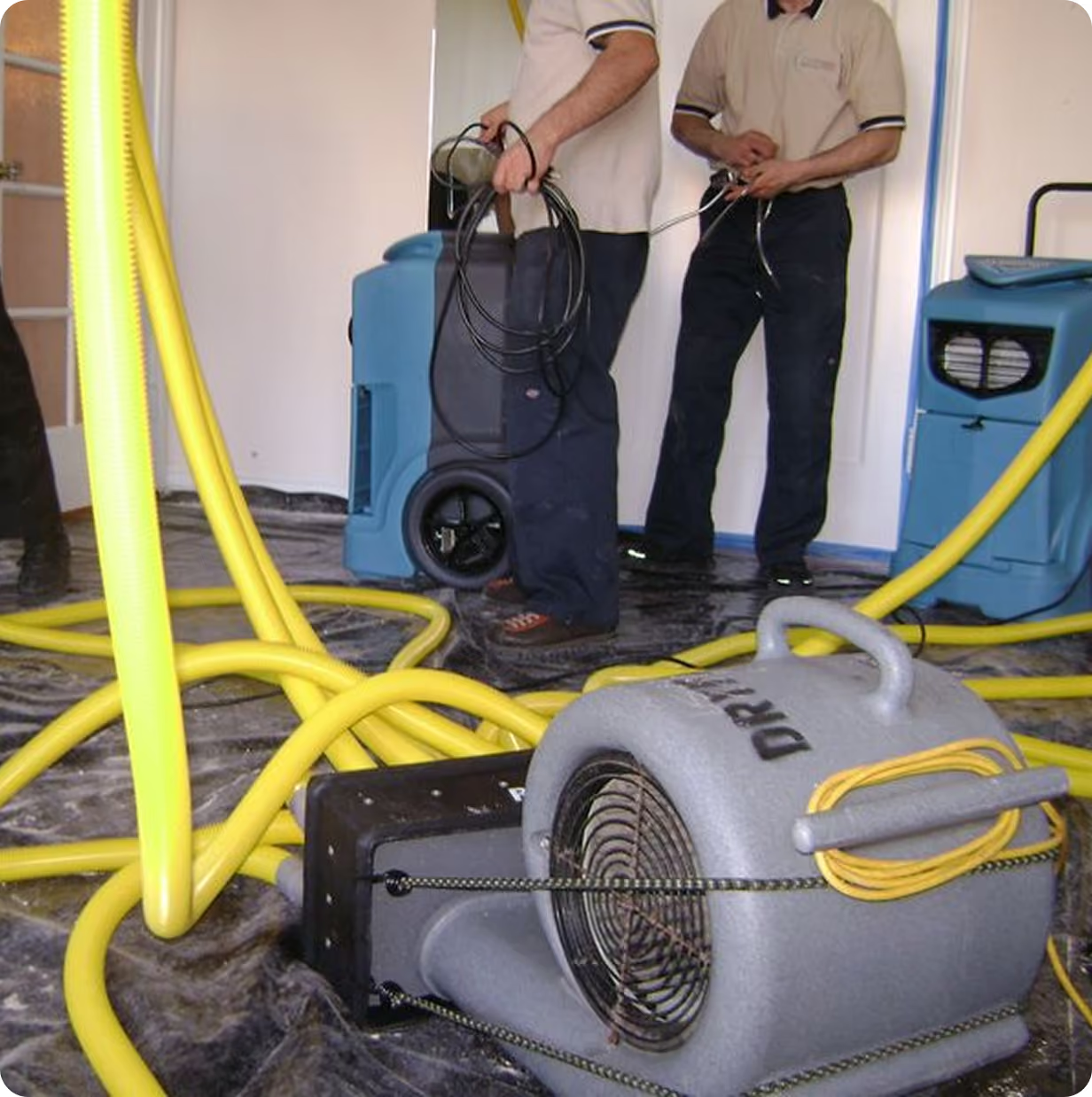
We position high-velocity air movers to create directional airflow through affected walls, floors, and ceilings. LGR (Low Grain Refrigerant) dehumidifiers pull moisture from the air and surrounding materials, driving readings down to the IICRC S500 dry standard. Drying typically takes 3 to 5 days, with technicians returning daily to take moisture readings and adjust equipment placement.

Mold Prevention Treatment
With structural moisture eliminated, we apply EPA-registered antimicrobial treatment to all affected surfaces. This preventive step closes the window for mold colonization, which can begin within 24 to 48 hours in untreated damp conditions.
If our moisture assessment identified any existing mold growth, a separate remediation protocol is initiated at this stage. BoneDry handles mold remediation in-house using negative air containment and HEPA filtration, no need to hire a separate contractor.

Restoration & Reconstruction
Once structural materials have been verified dry and treated, reconstruction begins. BoneDry handles the full rebuild in-house, drywall installation and finishing, flooring replacement, painting, framing repairs, and any other structural work required to return your property to pre-damage condition.
We do not subcontract your reconstruction to unknown third parties. The same team that managed your mitigation manages your rebuild, ensuring quality, continuity, and a single point of accountability from first call to final walkthrough.
Professional Water Damage Restoration Equipment We Use in Denver

Why Denver Homeowners Choose BoneDry for Water Damage Restoration

Available 24/7 for Emergency Services
(303) 276-4163IICRC Certified Firm
90-Minute Arrival Guarantee
Insurance Claim Experts
No Hidden Fees
Family-Owned, Colorado-Based
3,500+ Completed Projects
Available 24/7 for Emergency Services
(303) 276-4163Trusted by Homeowners Across Denver
.svg)

.svg)
.svg)
.svg)

I am going to steal a comment from the previous review - J.D. Stewart went above and beyond for me; That absolutely sums up my sentiment. While unlike the previous review, honestly I was not totally happy with the initial progress. JD was able to change my view of BoneDry. I acknowledge that every company has problems, but the important thing is to address them decisively and correct them rapidly. BoneDry did that with irreplaceable from JD. Because of that I am willing to overlook their (resolved) problems and recommend their services to anyone.
H K Wong
Bone Dry Services were great to work with. From Heidi always being available to communicate and answer our questions super quickly. To Ana, Burke, and Lina doing great work with a detailed cleaning. Jorge made sure everything was done to top quality, taking care of our house as if it was his own. And then JD, Manuel, and their team did a great carpet installation, making sure we were super happy with how it turned out. We definitely recommend!
Katie Coster
Roman and Francisco worked for two days on my place. The were hardworking and very polite. Excellent communication skills and kept me updated on everything that was happening. Bone dry services has two great employees.
Miller Crowe
My water heater flooded my home back in May 2025 and a plumber from AAA Service Plumbing, Heating, and Electric came out to replace it. When the plumber was at my home, he told me about Bone Dry Services and called them to come out. Bone Dry immediately came to my home and assessed the damages. And they immediately set up fans and dehumidifiers for mitigation of the water damages. I had already had a water damage claim opened up with my insurance carrier and so the process got started between Bone Dry and my insurance company.
Ashley Luntsford
JD got our small job patching a hole sorted out really quickly. His team was efficient and communicated with us really well through the whole process. You would never be able to tell there was a hole in the ceiling. Highly recommend!
.svg)
Beth Kent
I can’t recommend Bone Dry Services enough! From start to finish, their team went above and beyond to ensure my water damage issue was handled professionally and efficiently.
Tyson assessed the situation with expertise, not only identifying the problem but also taking the time to educate me on what to look for and how to better understand the issue. His knowledge and willingness to explain everything made a huge difference.
.svg)
Vinncent Nguyen
Maria and Karen were wonderful! I would definitely have Bone Dry out again if we need this type of cleaning. We had concrete dust covering everything after some restoration work, but these two ladies did a great job cleaning all my walls and floors. It feels a lot better in my house now.
.svg)
Dinae Dreessen
The whole Bonedry team really stepped up to help us with an entire bathroom restoration so we could close on our house in time! Brandon from the restoration team really stood out! He communication the entire time really went above and beyond. He was attentive and efficient! Thank you Brandon and Bonedry!
Chelsea Sapp
We had an unexpected water issue that flooded part of our basement on super bowl sunday and Bone Dry Services came to the rescue. From start to finish, the experience was professional, efficient, and stress-free. A huge shout out to Bryan R and Sara. Bryan was incredibly knowledgeable and thorough with the mitigation process, and Sara was so helpful and communicative throughout. They made a tough situation much easier to handle. Highly recommend Bone Dry Services for anyone dealing with water damage!
.svg)
Levi Johaston
John, Santiago and JJ were all wonderful to work with. Very knowledgeable, prompt, and kind. They didn't rush, took time to explain the process. I'd definitely recommend BoneDry Services. They even brought my trash can up from the road.
.svg)
Heather Ilgen
I’m so grateful for the help, attention to detail and customer service that Bone Dry has provided. It’s never convenient to have a pipe burst, but working with a company that has been kind, transparent and helped explain every step of the process has us given such peace of mind.

Megan Marshall
I run a plumbing company and needed help from a restoration company on a Sunday. They answered right away and were on the job site in less then an hour....... on a SUNDAY. Even though my customer was understandably upset, they dealt and worked with him and explained the restoration process. Colton and Connor are the best. If I ever need a restoration company they are going to be the only ones I call. Thanks guys. 🌟🌟🌟🌟🌟

lx Bernal
Water Damage Insurance Claims in Denver, We Handle the Paperwork
BoneDry has coordinated insurance claims for over 3,500 restoration projects across Colorado. Our team documents everything your adjuster needs, written damage reports, timestamped photographs, moisture mapping data, and equipment placement logs, so your claim has the strongest possible foundation.
We work directly with your adjuster. We answer their questions. We provide supplemental documentation if coverage is disputed. You focus on getting your life back to normal; we handle the paperwork.
What we handle on your behalf:


Is your damage covered?
Water Damage Restoration Service Area: Denver & the Front Range

Get Immediate Help
Lead Paint Removal
Fire Damage Restoration
Biohazard Cleanup
Sewage Cleanup
Emergency Board-Up
Structural Drying & Dehumidification
Contents Restoration
Asbestos Abatement
Odor Removal
24/7 Water Damage Restoration
Mold Removal & Remediation
Storm Damage Restoration
How quickly can BoneDry respond to water damage in Denver?

BoneDry will be on-site within 90 minutes of your call, anywhere in the Denver metro area.
Does homeowner insurance cover water damage restoration?
Most standard homeowner insurance policies cover water damage caused by sudden, accidental events, burst pipes, appliance malfunctions, and roof leaks from storms are the most common covered scenarios.
Flood damage from external water sources (rising rivers, storm runoff) typically requires a separate NFIP flood insurance policy. Gradual damage from slow leaks is generally excluded. BoneDry works directly with your adjuster and provides all necessary documentation to support your claim.
How long does water damage restoration take?
The timeline depends on the severity of damage and the materials affected. For most residential water damage, structural drying takes 3 to 5 days. Full restoration, including drywall repair, flooring replacement, and reconstruction, typically takes 1 to 3 weeks.
BoneDry provides a detailed timeline estimate after the initial moisture assessment. We return daily during the drying phase to take readings and adjust equipment, and we don't close a project until materials verify dry against IICRC S500 standards.
What is the difference between Category 1, 2, and 3 water damage?
Category 1 is clean water from a sanitary source, burst supply pipes or appliance leaks. Category 2 is grey water containing significant contamination, washing machine overflow or dishwasher leaks. Category 3 is black water, sewage backup or external flooding, which is a biohazard requiring professional cleanup under strict protocols.
BoneDry is trained and equipped to handle all three categories. Category classification determines the cleanup protocol, drying timeline, and the materials that can be salvaged versus must be removed.
Can I stay in my home during water damage restoration?
It depends on the category and severity of damage. Category 1 water damage, from a clean source like a burst pipe, is generally safe to remain in, provided the affected area is isolated and drying equipment is running.
Category 2 or Category 3 damage (grey or black water) may require temporary relocation due to health risks and air quality concerns during cleanup. BoneDry assesses this on-site and advises you directly based on the specific conditions of your property.
What causes water damage in Colorado homes?
The most common causes we respond to in the Denver area are frozen and burst pipes (during winter months when temperatures drop below 0°F), hail damage to roofing (Denver sits in Hail Alley), appliance failures (washing machines, water heaters, dishwashers), sump pump failures during spring snowmelt, and flash flooding in low-lying areas near the South Platte River corridor and Cherry Creek.
Colorado's climate creates a uniquely high water damage risk, more so than most U.S. states. Annual maintenance including sump pump testing, pipe insulation, and roof inspection is the best defense.
How do I prevent mold after water damage?
The single most important step is speed, professional structural drying must begin within 24 to 48 hours of water exposure. Mold does not need visible dampness to grow; it only requires materials to be above the IICRC dry standard threshold.
While waiting for BoneDry to arrive, remove as much standing water as possible using towels or a wet-dry vacuum, increase ventilation by opening windows if weather permits, and remove saturated area rugs. Do not run fans over Category 2 or 3 water, this can spread contamination. Once BoneDry arrives, our antimicrobial treatment closes the mold growth window during the drying process.
Do you offer free water damage inspections in Denver?
Yes. BoneDry provides a free on-site water damage inspection and moisture assessment for all properties in the Denver metro area. We use thermal imaging cameras to identify hidden moisture and calibrated moisture meters to establish the full scope of damage, at no charge, with no obligation.
You'll receive a clear picture of the damage extent and a transparent restoration estimate before any work begins. No trip fees. No pressure. Call (303) 276-4163 to schedule.
Water Damage Doesn't Wait
No trip fees
We work with your insurance
Denver's trusted water damage restoration experts
Follow Us


